https://crm.veedhi.co.in/backPanel/scanner/register_form_scanner.php?uid=146
Why Checking Mutual Fund Overlap Matters for Smart Investing
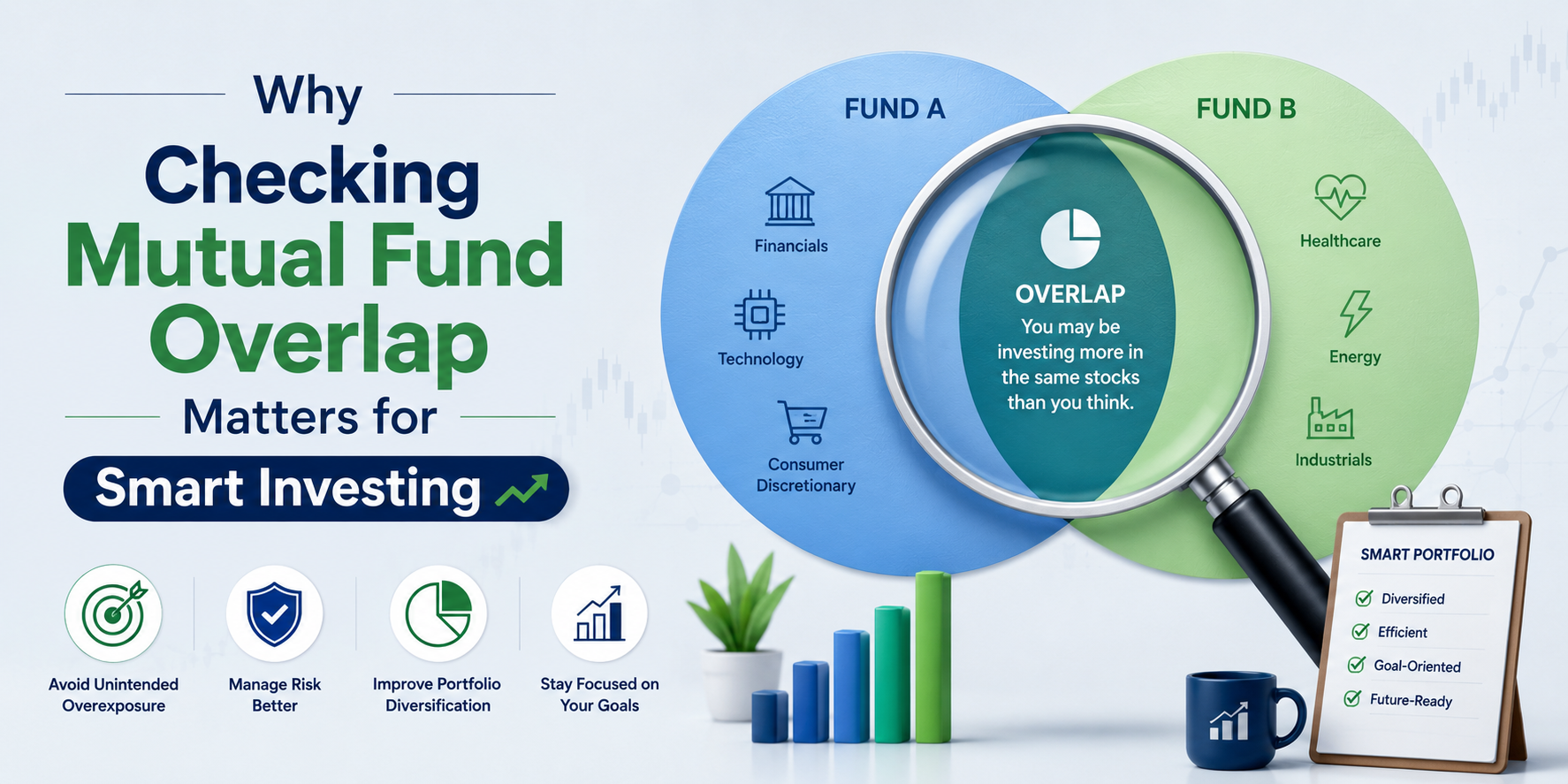
Many investors believe that holding multiple mutual funds automatically means better diversification. But what if your portfolio contains several funds that invest in almost the same stocks? This hidden issue is known as mutual fund overlap, and it can quietly affect your portfolio performance without you even realizing it.
At Veedhi, we believe investors should not only focus on fund ratings and past returns but also understand what their investments actually hold. A mutual fund overlap calculator helps reveal whether your portfolio is genuinely diversified or simply repeating the same investments through multiple schemes.
Understanding Mutual Fund Overlap
Mutual fund overlap happens when two or more funds in your portfolio own many of the same stocks in similar proportions. Even if the funds belong to different Asset Management Companies (AMCs), they can still invest heavily in identical companies.
This creates a false sense of diversification. Instead of spreading risk, you may unknowingly concentrate your money in a small group of stocks or sectors.
For example, an investor may hold three different large-cap mutual funds thinking they provide broad market exposure. However, after checking the portfolio holdings, it may turn out that all three funds own the same top companies like:
- HDFC Bank Ltd.
- ICICI Bank Ltd.
- Reliance Industries Ltd.
- Larsen & Toubro Ltd.
- State Bank of India
In such cases, the investor is not truly diversified. The portfolio is simply repeating the same investment strategy multiple times.
A Real-Life Investment Scenario
Consider a young investor named Rohan, a 27-year-old software engineer who started investing for long-term wealth creation. Over four years, he added multiple top-rated large-cap mutual funds to his portfolio based on recommendations, performance rankings, and financial news coverage.
Since the funds came from different AMCs, he assumed his investments were well diversified.
However, when he analysed his portfolio using a mutual fund overlap calculator, the results were surprising:
Fund ComparisonOverlap PercentageFund A vs Fund B73%Fund B vs Fund C67%Fund A vs Fund C62%
The analysis revealed that most of his investments were concentrated in the same group of large-cap stocks. Instead of diversification, he was paying multiple fund management fees for nearly identical exposure.
Why Overlap Can Be Risky
1. Increased Concentration Risk
When the same stocks appear across multiple funds, your portfolio becomes heavily dependent on a few companies or sectors.
For example, if banking stocks decline sharply, portfolios heavily invested in HDFC Bank, ICICI Bank, or SBI across several funds may experience larger losses than expected.
2. Reduced Diversification Benefits
The purpose of diversification is to spread investments across different sectors, market caps, and asset classes. Excessive overlap defeats this purpose.
Even though you may own several mutual funds, your actual exposure may remain limited to a narrow section of the market.
3. Higher Costs Without Additional Value
Holding multiple overlapping funds often means paying additional expense ratios without gaining meaningful portfolio diversification.
Instead of improving returns, the investor simply duplicates the same holdings repeatedly.
Why Large-Cap Funds Often Overlap
SEBI regulations require large-cap mutual funds to invest at least 80% of their assets in the top 100 companies by market capitalization.
Since all fund managers operate within the same pool of large companies, some level of overlap becomes unavoidable. However, excessive overlap across multiple large-cap funds may reduce the effectiveness of your overall asset allocation.
This is why investors should not blindly invest in multiple “top-performing” funds without analysing their underlying holdings.
How a Mutual Fund Overlap Calculator Helps
A mutual fund overlap calculator provides a detailed analysis of your portfolio and helps identify hidden concentration risks.
It can help investors:
- Identify overlapping stocks across schemes
- Understand sector concentration
- Compare portfolio diversification levels
- Evaluate new funds before investing
- Reduce unnecessary duplication
- Improve asset allocation decisions
Instead of manually comparing monthly fund fact sheets, the calculator provides quick and accurate insights within minutes.
SEBI’s Push for Greater Transparency
In a positive move for investors, SEBI has introduced new transparency measures regarding portfolio overlap.
From August 2026, fund houses will be required to publish monthly overlap reports between their schemes. This will help investors better understand whether multiple funds from the same AMC are investing in similar stocks.
SEBI has also introduced overlap restrictions for sectoral and thematic funds to reduce excessive concentration risks.
Building a Truly Diversified Portfolio
A strong portfolio is not built by collecting multiple popular funds. It is built through proper financial planning and thoughtful asset allocation.
Your investment choices should reflect:
- Your financial goals
- Investment horizon
- Risk tolerance
- Income stability
- Existing liabilities
- Future financial responsibilities
For young investors with long investment horizons, diversification across equity categories, debt instruments, gold ETFs, REITs, and international exposure may create a more balanced portfolio structure.
Final Thoughts
Many investors unknowingly hold portfolios filled with overlapping mutual funds. While the fund names may look different, the underlying investments are often remarkably similar.
Checking mutual fund overlap is one of the simplest yet most important steps toward smarter investing. It helps investors avoid concentration risk, improve diversification, and make more informed financial decisions.
At Veedhi, we encourage investors to go beyond fund ratings and understand the real structure of their portfolio. A mutual fund overlap calculator can provide the clarity needed to build a portfolio aligned with your long-term financial goals.
Before adding another mutual fund to your portfolio, ask yourself one important question:
Am I truly diversifying, or simply buying the same stocks again in a different package?