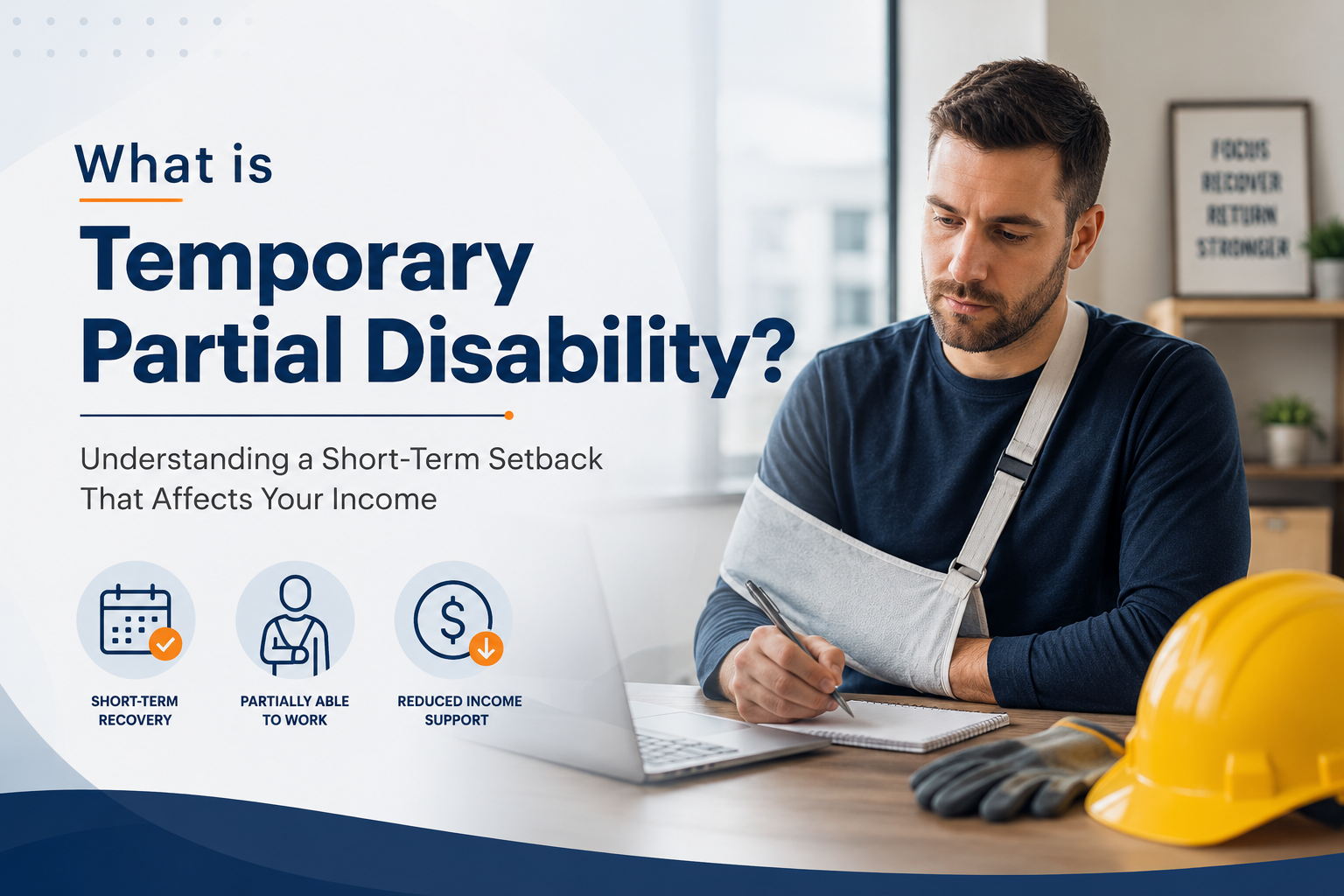
What is Temporary Partial Disability? Understanding a Short-Term Setback That Affects Your Income
Life can change in a matter of seconds. A workplace accident, a road mishap, or even a simple fall can lead to injuries that make it difficult to perform your job as usual. However, not every injury leaves a person completely unable to work. In many cases, individuals can continue working but with limitations. This is where Temporary Partial Disability (TPD) comes into the picture.
Temporary Partial Disability is a term commonly used in insurance and employee compensation programs to describe a situation where a person suffers an injury that temporarily reduces their ability to work and earn income. While the individual is not fully disabled, they cannot perform their regular duties at the same level as before the injury.
Understanding Temporary Partial Disability is important because it highlights how insurance and compensation benefits can provide financial support during recovery.
Understanding Temporary Partial Disability in Simple Terms
Imagine a delivery executive who injures his knee in an accident. He can no longer ride a motorcycle for long hours but is still capable of handling office-related tasks. Since he can work in a limited capacity, he is not considered totally disabled. However, because his earning potential has decreased temporarily, he may qualify for Temporary Partial Disability benefits.
The word temporary indicates that the condition is expected to improve with treatment and time. The word partial means the person retains some ability to work, even though they cannot perform all their normal responsibilities.
In short, Temporary Partial Disability applies when an injury causes a temporary reduction in work capacity rather than a complete inability to work.
Why Temporary Partial Disability Matters
Many people assume that compensation is available only when someone is completely unable to work. In reality, a significant number of injuries fall into the partial disability category.
An employee recovering from an injury may:
- Work fewer hours than before.
- Shift to a lighter-duty role.
- Avoid physically demanding tasks.
- Experience reduced productivity.
- Earn less income during recovery.
Without financial assistance, this loss of earning capacity can place pressure on household finances. Temporary Partial Disability benefits are designed to reduce that burden and help individuals maintain financial stability while they recover.
Common Situations That Can Lead to Temporary Partial Disability
Temporary Partial Disability can result from various injuries and medical conditions. Some common examples include:
Bone Fractures
A person with a fractured arm or leg may be unable to perform certain physical tasks but may still be capable of handling desk-based work.
Muscle and Ligament Injuries
Strains, sprains, and ligament tears often require rest and rehabilitation, limiting a person's physical abilities for a period of time.
Back Injuries
Back pain or spinal injuries can restrict lifting, bending, and prolonged standing, affecting job performance.
Minor Burns
Burn injuries may temporarily limit mobility and the ability to use certain body parts effectively.
Post-Surgery Recovery
After surgery, individuals may be cleared for light work while they continue recovering.
In all these situations, the person may still be employable but not at their normal level of performance.
How Temporary Partial Disability Affects Income
One of the biggest challenges during recovery is reduced earnings.
For example, consider an employee who earns ₹40,000 per month performing physically demanding work. After an injury, the employee may be shifted to a lighter role that pays ₹28,000 per month.
Although the employee continues working, there is a monthly income gap of ₹12,000.
Temporary Partial Disability benefits are intended to compensate for a portion of this loss. The exact amount depends on policy terms, compensation laws, and the nature of the disability.
The goal is not to replace the entire income but to provide financial support until the individual recovers and returns to normal duties.
Temporary Partial Disability vs Permanent Partial Disability
People often confuse Temporary Partial Disability with Permanent Partial Disability.
Temporary Partial Disability
- Recovery is expected.
- Work capacity is reduced for a limited period.
- Benefits stop once the individual recovers.
- The condition is not considered permanent.
Permanent Partial Disability
- The injury causes lasting impairment.
- Full recovery may not be possible.
- The person may permanently lose some physical function.
- Long-term compensation may apply.
The main difference lies in the expected recovery. Temporary Partial Disability is a short-term condition, while Permanent Partial Disability involves lasting effects.
The Importance of Disability Insurance Coverage
Accidents do not just affect health—they can also affect financial security. This is why disability coverage has become an important feature in many personal accident insurance plans and employee benefit programs.
Having adequate coverage can help:
- Manage day-to-day expenses.
- Reduce financial stress during treatment.
- Protect family savings.
- Support medical and rehabilitation costs.
- Provide income continuity during recovery.
For individuals who depend on a regular salary, disability protection can be as important as life or health insurance.
What Should You Do After an Injury?
If you experience an injury that affects your ability to work, taking the right steps can make the recovery and claim process smoother.
Seek Immediate Medical Care
Prompt medical attention ensures proper treatment and creates official documentation of the injury.
Inform the Employer or Insurer
Reporting the incident quickly helps avoid delays in processing claims.
Keep All Records
Medical reports, prescriptions, diagnostic tests, and salary details may be required during claim evaluation.
Follow the Recovery Plan
Insurance providers often expect policyholders to follow prescribed treatment and rehabilitation programs.
Understand Your Coverage
Review your insurance policy carefully to know the benefits, exclusions, and claim requirements related to disability coverage.
Conclusion
Temporary Partial Disability is more than just a medical condition—it is a financial challenge that many people face after an injury. While individuals affected by Temporary Partial Disability can still work, their ability to perform at full capacity and earn their usual income may be temporarily reduced.
This is where disability benefits play a crucial role. They provide financial assistance during recovery, helping individuals focus on healing rather than worrying about lost income. Whether you are an employee, self-employed professional, or insurance policyholder, understanding Temporary Partial Disability can help you prepare for unexpected situations and make better decisions about financial protection.
In today's uncertain world, having the right disability coverage can turn a temporary setback into a manageable phase of recovery and growth.