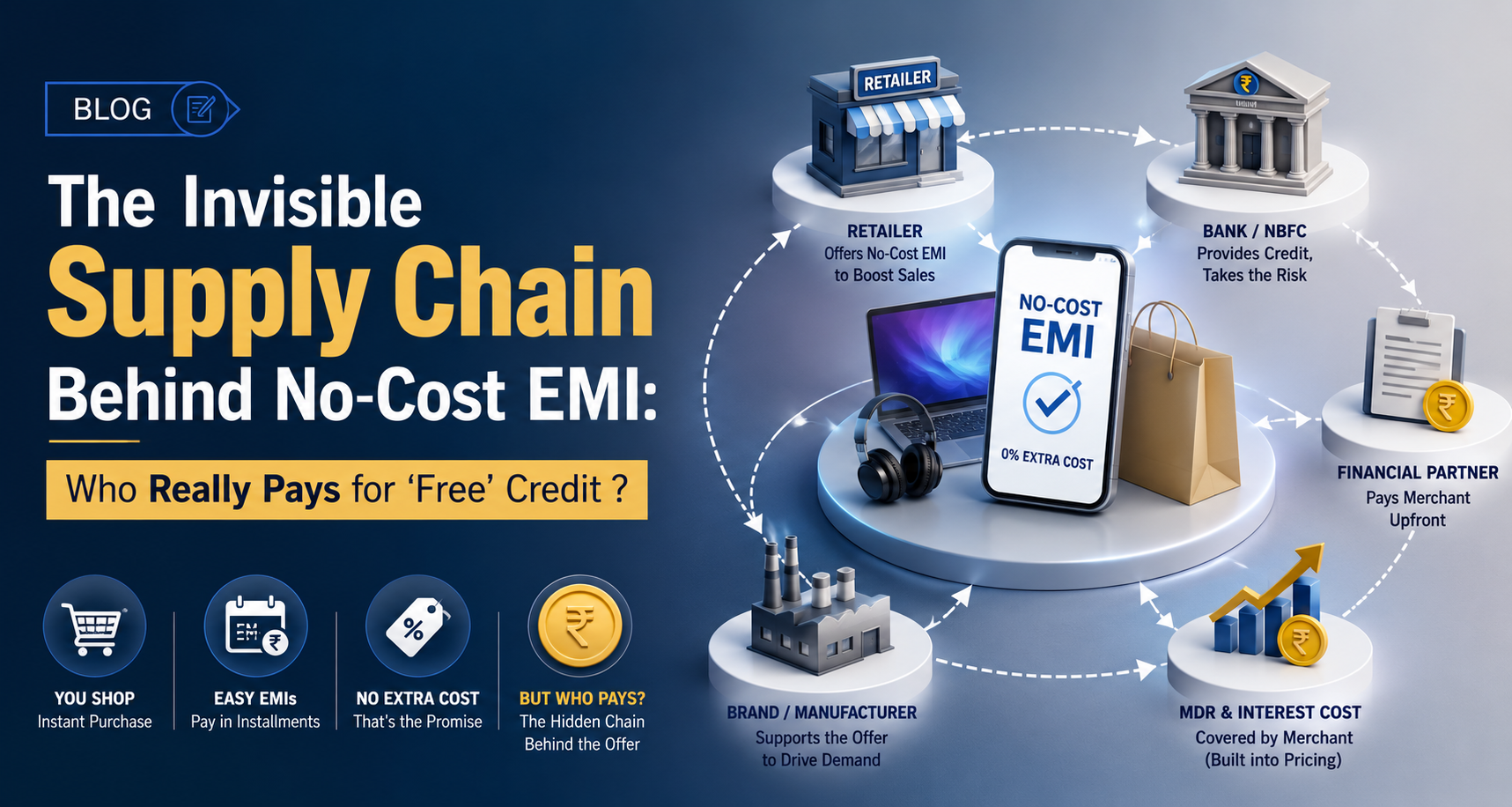
The Invisible Supply Chain Behind No-Cost EMI: Who Really Pays for ‘Free’ Credit ?
New Delhi: A customer walks into a store and buys a ₹75,000 smartphone on a 12-month No-Cost EMI plan. The salesperson promises zero interest, affordable monthly payments, and instant approval. It sounds like a financial win for everyone involved.
But behind this seemingly simple transaction lies a complex economic ecosystem where banks, retailers, brands, and payment networks quietly redistribute costs—proving that in finance, "free" rarely means costless.
For years, No-Cost EMI has transformed India's retail landscape, helping consumers purchase everything from smartphones and laptops to furniture and home appliances without paying the full amount upfront. During festive sales, these schemes have become one of the strongest drivers of consumer spending.
The question is: if the buyer isn't paying interest, who is?
The Hidden Economics of Zero Interest
Traditionally, lenders earn revenue through interest charged on borrowed money. No-Cost EMI changes the equation. Instead of collecting interest directly from consumers, banks often receive compensation from manufacturers or merchants eager to boost sales.
In many cases, brands provide an upfront discount equivalent to the interest amount. The customer pays the product price through installments, while the bank still earns its expected return. The cost is absorbed elsewhere in the value chain.
For retailers, this arrangement is often viewed as a marketing expense rather than a financing cost. By lowering the psychological barrier to purchase, No-Cost EMI encourages consumers to buy higher-value products and upgrade more frequently.
Selling Affordability, Not Products
Behavioral economists argue that No-Cost EMI doesn't just change how people pay—it changes how they think.
A ₹60,000 smartphone may feel expensive when viewed as a one-time purchase. Presented as ₹5,000 per month, however, the same device suddenly appears affordable. Consumers begin evaluating products based on monthly cash flow rather than total ownership cost.
This shift has fueled what analysts describe as the "subscription mindset" in retail. Much like streaming services transformed entertainment spending, EMI-based purchases are transforming consumer goods into recurring monthly commitments.
The Opportunity Cost Consumers Rarely Notice
While the headline promise is "zero interest," consumers may still incur indirect costs.
Some EMI offers require customers to forgo cash discounts, cashback rewards, or loyalty benefits that would otherwise reduce the effective purchase price. Processing fees and taxes may also apply, depending on the lender and transaction structure.
Financial planners warn that the biggest risk is not hidden fees but the accumulation of multiple EMIs. Individually manageable payments can collectively reduce future disposable income and limit financial flexibility.
A Data Goldmine for Lenders
The benefits extend beyond increased sales.
Every EMI transaction generates valuable consumer data. Banks gain insights into spending patterns, repayment behavior, and purchasing preferences. This information helps financial institutions identify potential customers for credit cards, personal loans, insurance products, and other financial services.
In that sense, the EMI itself may be less valuable than the long-term customer relationship it creates.
The Future of Consumer Credit
As digital payments expand and fintech companies compete for market share, No-Cost EMI is increasingly becoming a strategic tool rather than merely a financing option. It stimulates demand, drives customer acquisition, and encourages spending during periods of economic uncertainty.
For consumers, the offer remains attractive. For businesses, it is a powerful sales engine.
The next time a salesperson says, "It's on No-Cost EMI," the more interesting question may not be how much you'll pay each month—but who is paying the cost that you don't see.